April 26, 2026 • Cara Meltzer • 9 min reading time • Prices verified June 5, 2026
Immersion Blender Buying Guide: Motor Specs, Splatter Patterns, and Which Brands Hold Up
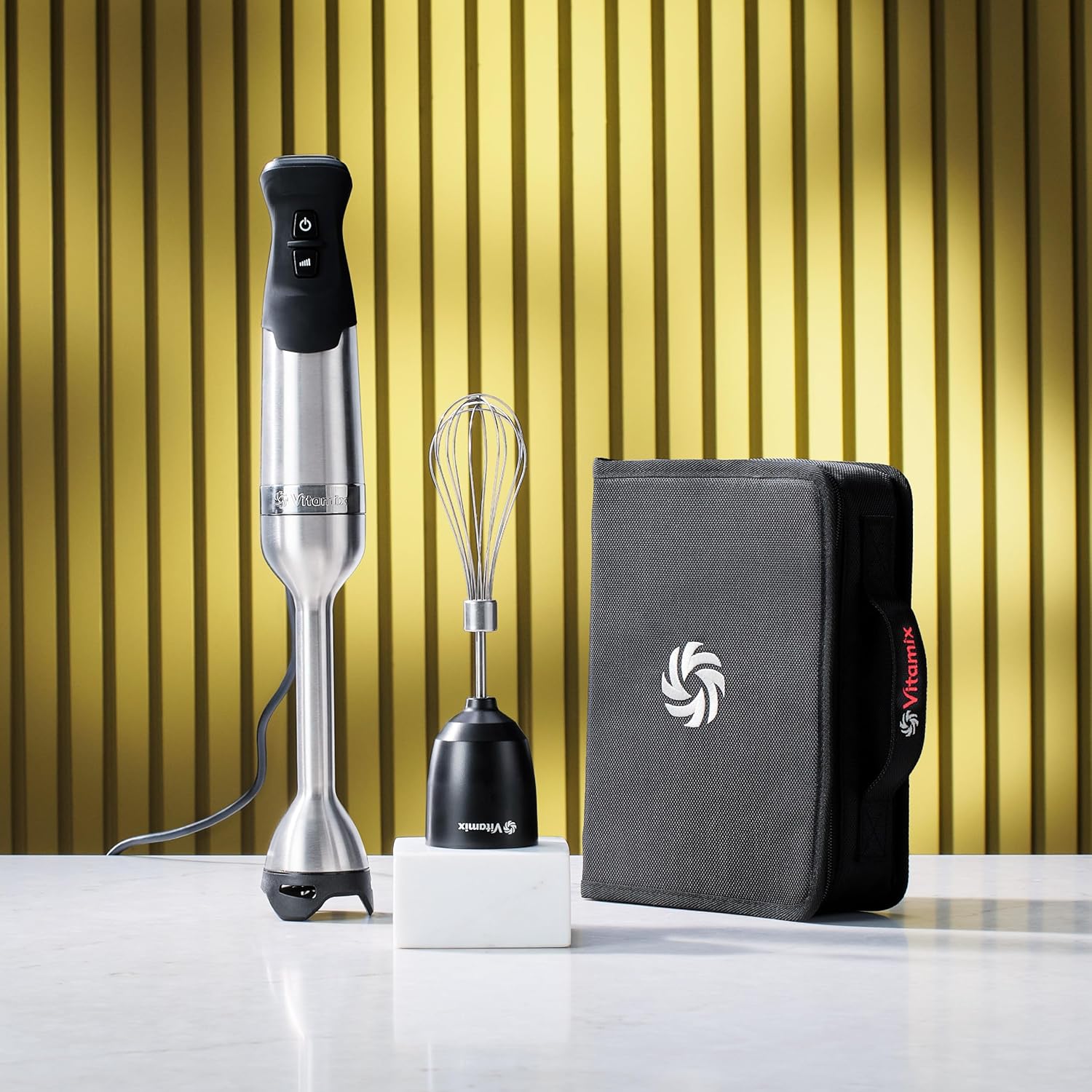
An immersion blender — also called a stick blender or hand blender — is a handheld device you lower directly into your pot, bowl, or cup to blend food in place, without transferring hot soup or sauce into a separate jar. If you’ve ever scorched your thumb on a blender lid trying to puree a batch of butternut squash, you already understand the appeal. The pitch is convenience: one tool, minimal cleanup, no moving a scalding liquid from point A to point B. But convenience only holds up if the motor is strong enough, the blade guard (the perforated cage around the cutting head) controls splatter, and the build quality survives a few years of actual cooking — and that’s where buyers run into real tradeoffs. This guide is for the cook who is past “just grab something cheap” and wants to make a deliberate choice between the $50 entry tier, the $100–$180 mid-range, and the $200–$350 professional-adjacent options. We’ll name the tradeoffs explicitly, show the math, and give you a clear decision rule at the end.
| EDITOR'S PICK[Vitamix 5-Speed Immersion Blend…](https://www.amazon.com/dp/B08DDJMBZM?tag=greenflower20-20) | Mid-tier[Cuisinart CSB-179 Smart Stick V…](https://www.amazon.com/dp/B079NJTL29?tag=greenflower20-20) | Budget pick[OVENTE Immersion Hand Blender](https://www.amazon.com/dp/B079MJ68Y9?tag=greenflower20-20) | |
|---|---|---|---|
| Motor Power | 625W | — | 300W |
| Speeds | 5 | Variable | 2 |
| Attachments | Whisk, Case | — | — |
| Price | $199.95 | $69.99 | $14.99 |
| See on Amazon → | See on Amazon → | See on Amazon → |
Motor Power: What the Wattage Numbers Actually Mean
Immersion blender wattage runs from roughly 200W on the low end to 1,200W on a handful of commercial-intended outliers. For home cooking, the practical range where things get interesting is 300W to 800W — and even within that band, raw wattage is a notoriously incomplete proxy for real-world performance.
Here’s why: wattage measures how much electricity the motor draws, not how efficiently it converts that draw into blade torque. A well-engineered 400W motor with a quality blade-to-cup seal can outperform a sloppy 600W unit on thick jobs like hummus or frozen-fruit smoothies. Wirecutter’s coverage of immersion blenders notes this directly, pointing out that their top picks have clustered around 300–500W rather than the high-wattage outliers — because blade design and guard geometry do at least as much work as motor size.
That said, wattage still tells you something real about sustained load performance. If you’re regularly blending large-batch soups (think 6–8 quarts), nut-based sauces, or anything with fibrous vegetables like celery root, a motor below 300W will thermal-cycle — meaning it will overheat and cut out, requiring a rest before you can continue. In that volume bracket, the 500W–800W range gives meaningful headroom.
The spec to read alongside wattage: variable speed. A single-speed stick blender gives you one option — full blast — which is fine for thin soups but creates a splatter problem with chunky or thick mixtures. Two-speed or continuously variable (dial or trigger-pressure) controls let you start slow in the food, build speed, and maintain better containment. Serious Eats has consistently flagged variable-speed control as one of the highest-value features at the mid-range price point, noting that owners of variable-speed models report significantly less mess and better texture control on delicate emulsions like mayonnaise.
By the Numbers
| Price tier | Typical wattage | Speed control | Best suited for |
|---|---|---|---|
| $30–$60 | 200–300W | Single speed | Occasional thin soups, baby food |
| $80–$150 | 300–500W | 2-speed or variable | Daily cooking, medium-batch work |
| $180–$350 | 500–800W | Variable + turbo | Large batches, thick blends, semi-pro use |
Splatter Patterns: Why the Blade Guard Is the Real Design Story
Splatter is the user-experience problem that separates a thoughtfully designed stick blender from a frustrating one — and it’s almost entirely a function of how the blade guard is shaped, how many holes it has, and how deep the blade sits within it.
The blade guard (that perforated dome or cage at the bottom of the shaft) does two jobs simultaneously: it lets food in to contact the blade, and it manages how aggressively the blended material exits back into the container. A guard with large, widely-spaced holes and a shallow blade depth will move food fast but throw it in all directions. A guard with smaller, more numerous holes and a blade recessed deeper into the housing creates more of a controlled vortex — more contained, less explosive.
Good Housekeeping’s immersion blender evaluations have noted that the blade guard design is the single most consistent differentiator between models that reviewers describe as “splatter-prone” versus “clean to use.” Brands that get this right — and owners consistently reward in reviews — include Breville (particularly the Control Grip line), KitchenAid’s corded models, and the Vitamix Immersion Blender at the upper tier.
Practical tip from aggregated owner reviews: splatter is dramatically reduced when the blade guard is fully submerged before you power on the motor. Starting the blade in open air, then dipping it into liquid, is the single most common user error that leads to splatter disasters. The physics make sense: you want the guard’s vortex to establish inside the food, not to accelerate into it from above.
Shaft length also matters more than most buyers realize. A standard 7–8” shaft works for a standard saucepan, but if you work with a tall stockpot or a deep restaurant container, a 10–12” shaft keeps your hand well above the liquid surface. Several mid-range Braun models and the All-Clad Cordless offer extended shaft options — something you genuinely won’t care about until the day you need it.
Which Brands Hold Up: A Research-Informed Brand Landscape
This is where intermediate buyers tend to want specifics, so here’s what the published record — across Cook’s Illustrated’s equipment coverage, Wirecutter’s long-term update notes, and aggregated owner reviews — consistently shows.
Braun is the name that comes up most often in the “reliable workhorse” category. The MultiQuick line has been iterated over many generations, and the core engineering — particularly the EasyClick attachment system and the ACTIVEdrive blade technology on higher models — has earned the brand a reputation for consistency over time. Cook’s Illustrated has named Braun models as top picks in multiple evaluation rounds, citing blade efficiency and ease of cleaning as differentiating strengths. The warranty is standard (1–2 years depending on model), and replacement parts are widely available — a genuine practical advantage if you’re thinking about 5-year cost of ownership.
Breville plays in a slightly higher price band and earns it with build quality that owners describe as noticeably more substantial in hand. The Control Grip series specifically draws consistent praise for its ergonomics and — critically for the splatter question above — a guard design that reviewers describe as unusually well-contained. Breville’s customer service history is also generally positive in aggregated reviews, which matters when you’re spending $120–$180 on a handheld appliance.
Vitamix entered the immersion blender market relatively recently with a single model currently sitting around $100. Given the brand’s reputation in countertop blenders, expectations are high, and the reception has been somewhat mixed: reviewers at Wirecutter and Serious Eats note that the Vitamix Immersion Blender delivers genuinely strong blending performance — particularly on nut butters and thick soups — but that the ergonomics are not quite as refined as Braun or Breville at similar price points. If you’re already a Vitamix ecosystem buyer and want a companion tool with matching performance DNA, it’s a defensible choice. If you’re brand-agnostic, Braun or Breville likely deliver more per dollar.
KitchenAid cordless models occupy an interesting niche: the freedom from a cord genuinely changes how you use a stick blender, particularly at a stove where outlet proximity is annoying. Owners report solid battery life for typical tasks (thin-to-medium soups, smoothies, salad dressings), but battery-dependent torque means the cordless option is not recommended for sustained thick-blend work. Cordless KitchenAid is a secondary-tool buy, not a primary workhorse for heavy-volume cooks.
The brands to approach carefully: generic and no-name options flooding the $25–$45 bracket online. The motor specs listed are often aspirational rather than verified, blade quality varies significantly between production runs, and the warranty support (if it exists at all) tends to be difficult to access. For occasional use you can get away with it, but the $50 gap between a $40 no-name and a $90 entry-level Braun or Mueller is genuinely worth it in durability terms.
Attachments, Accessories, and the Bundle Math
Most immersion blenders at the $80+ tier are sold with or offer optional attachments: a whisk (for whipped cream and eggs), a mini chopper bowl (for small-batch herbs and garlic), and occasionally a frother wand. The question is whether the bundle price makes the attachments worth acquiring, or whether you’re better served buying a dedicated tool for each function.
The honest answer depends on volume and frequency. The whisk attachment on a stick blender is genuinely useful for small-batch applications — enough cream for two, a quick vinaigrette — but it will not replicate a stand mixer for high-volume or extended tasks. The mini chopper is similarly capable for small jobs (fresh herbs, a single shallot) but frustrating if you’re prepping for a dinner party. Think of the attachments as convenience additions for an existing use case, not as tools that replace dedicated equipment.
Where the bundle math gets interesting: models like the Braun MultiQuick 9 bundle the whisk and chopper at a package price that represents roughly 30–40% savings over buying the attachments separately — a real discount if you’ll use them. If you only want the stick blender itself, the base model is the more efficient buy.
The Decision Rule: If X, Then Y
Here’s the framework, stated plainly:
If you cook for 1–2 people, mostly thin soups and smoothies, and want to spend under $80: the Braun MultiQuick 5 or a comparable Mueller entry-level model gives you more than enough. Don’t overspend here.
If you cook for a household of 3–5, run regular batch cooking, and want a tool that handles thick soups, emulsified sauces, and occasional nut-based work: budget $100–$160 and target the Braun MultiQuick 7 or 9, or the Breville Control Grip. Variable speed is non-negotiable at this use level.
If you’re running a semi-professional setup — personal chef, small meal prep service, high-volume household — or you simply want to buy once and not think about it again: $180–$250 gets you into the Breville BSB530XL territory or the upper Braun MultiQuick Pro range, where the motor headroom and build quality are meaningfully different from mid-tier options. The Vitamix Immersion Blender is also worth evaluating here if you’re already in the Vitamix ecosystem.
The splatter rule applies universally: regardless of price tier, submerge the blade guard fully before starting the motor. Every time. It’s not a technique for experts — it’s the thing that makes any stick blender significantly more pleasant to use.
The immersion blender is one of those tools where the right choice depends almost entirely on volume and frequency rather than brand prestige. Honest research — from Cook’s Illustrated, Wirecutter, Serious Eats, and Good Housekeeping’s coverage over multiple evaluation cycles — consistently shows that the $100–$160 mid-tier is where the value-to-performance curve peaks for most home cooks. Below that, the motor limitations become real. Above it, you’re paying for durability and headroom that only sustained heavy use will justify. Know your use case, match the tier, and don’t let a spec sheet sell you past your actual needs.