May 20, 2026 • Cara Meltzer • 9 min reading time • Prices verified June 5, 2026
Single-Serve Blender Showdown: Which Cup-and-Go Machine Survives a Fitness Household
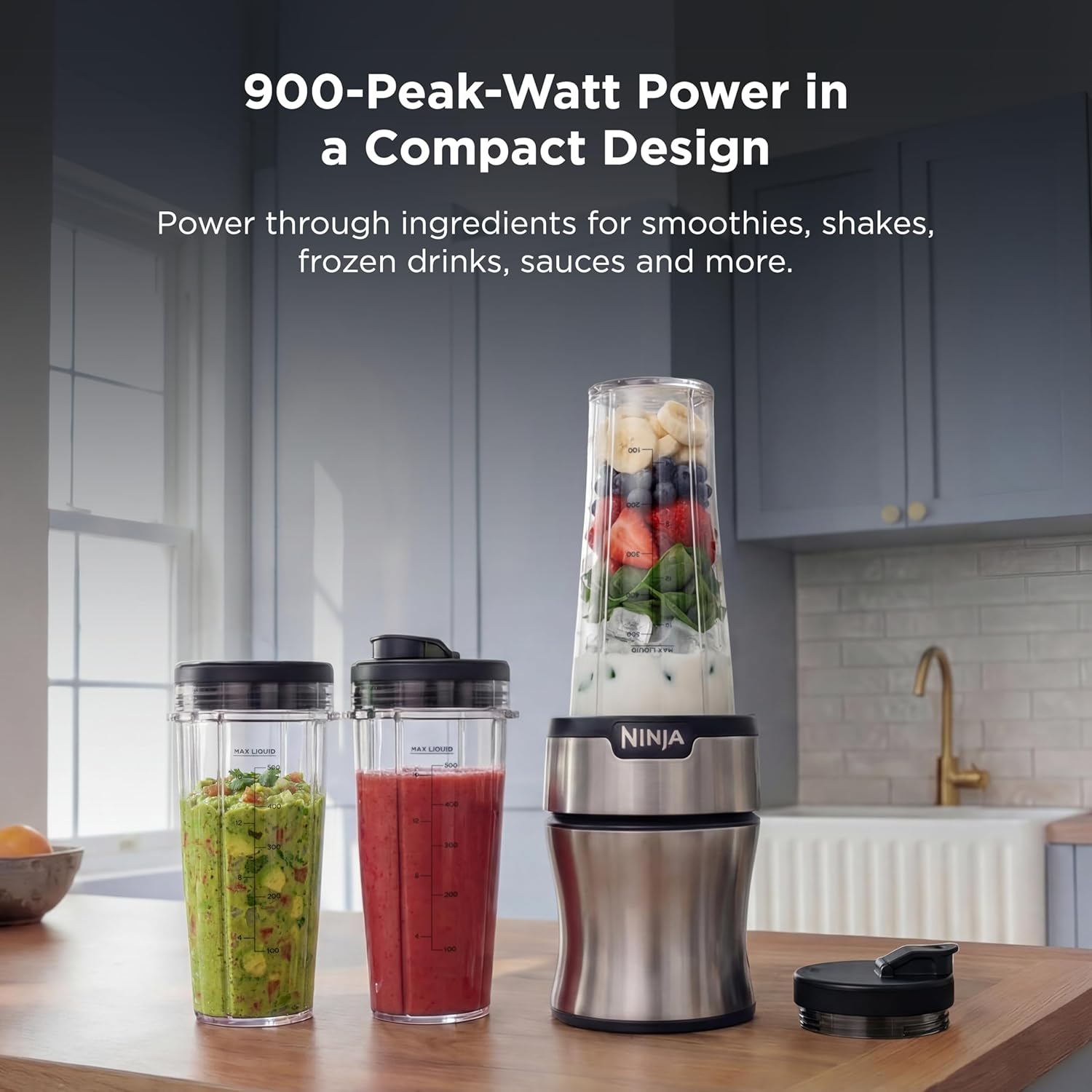
If your current blender routine ends with chunks of frozen fruit rattling around the bottom of the cup, you are not alone — and you are probably not using the right machine. A personal blender (that’s the countertop category where the cup you blend in doubles as the travel container you walk out the door with) sounds simple, but the gap between a $35 gas-station-shelf model and a $150 serious contender is enormous. Motor strength, blade design, and how the cup seals all determine whether your frozen spinach-and-berry blend comes out silky or grainy. This guide is for fitness households — people who are blending at least once a day, often with frozen fruit, protein powder, or both — who want to know which machines are actually worth buying and, equally important, which ones will die on them inside six months.
Below, we’ll walk through the competitive field, name tradeoffs explicitly, run the cost-per-use math, and give you a clear decision rule at the end.
| EDITOR'S PICK[Ninja Nutri-Plus Personal Blend](https://www.amazon.com/dp/B08QXJ31WR?tag=greenflower20-20)… | Mid-tier[Ninja Fit Compact Personal Blen](https://www.amazon.com/dp/B01FHOWYA2?tag=greenflower20-20)… | Budget pick[Magic Bullet Blender](https://www.amazon.com/dp/B012T634SM?tag=greenflower20-20) | |
|---|---|---|---|
| Motor power | 900 W | 700 W | — |
| Cup capacity | 20 oz. | 16 oz. | — |
| Cups included | 3 | 2 | — |
| Spout lids | 2 | 2 | — |
| Push to blend | ✓ | ✓ | — |
| Set count | — | — | 11 |
| Price | $89.99 | $69.99 | $34.99 |
| See on Amazon → | See on Amazon → | See on Amazon → |
The Field: Who’s Actually Competing Here
The personal blender market in mid-2026 clusters into three price bands, and knowing which band you’re shopping in changes the conversation entirely.
$30–$60 (Entry): NutriBullet Original (600W), Hamilton Beach Personal Blender. These dominate Amazon sales volume. They’re fine for soft fruit and yogurt. They struggle noticeably with frozen ingredients and tend to heat up under sustained daily use.
$70–$130 (Mid-tier): NutriBullet Pro+ (1200W), Ninja Fit (700W), Ninja BN401 Nutri Pro (1100W). This is where daily fitness-household use starts to become viable. Motor headroom increases, and most of these ship with multiple cup sizes.
$140–$200 (Serious): Vitamix ONE, Blendtec GO! Vortex, Nutribullet ULTRA. At this tier, you’re buying commercial-adjacent blade geometry, longer warranties, and enough motor reserve that frozen açaí packs and two scoops of whey protein don’t make the machine labor audibly.
The Wirecutter’s personal blender coverage (updated 2025) consistently separates mid-tier machines from premium ones on exactly this axis: whether the blade assembly can handle repeated frozen loads without degrading performance or burning out the coupling — the rubber or plastic piece that connects the blade unit to the motor.
The Tradeoffs That Actually Matter
Motor Wattage vs. Peak vs. Continuous
Spec sheets are slippery here. “Peak horsepower” and “peak watts” are marketing numbers — they represent what the motor can momentarily spike to, not what it sustains. What matters for a fitness household running one to two blends daily is continuous-duty rating, and most brands don’t publish that number cleanly.
The pattern across aggregated reviews: machines in the 900–1200W range handle daily frozen-ingredient use meaningfully better than 600W models, but beyond 1200W the real-world gains get harder to detect in single-serve cup formats — the cup volume limits how hard the motor actually has to work.
Consumer Reports’ blender buying guide notes that wattage alone is a poor predictor of blending performance; blade geometry, container shape, and the vortex (the downward spiral of ingredients toward the blade) matter as much as raw power output.
Blade and Coupling Longevity
This is the fitness household’s real failure mode. You’re not just blending; you’re blending frozen things, every day, for years. The blade-to-cup coupling — particularly on NutriBullet-style twist-on designs — is the component that owners most frequently report degrading first. Across long-run owner reviews aggregated on sites like Good Housekeeping and Wirecutter, NutriBullet Original owners regularly note coupling wear within 18–24 months of daily use; Pro and Pro+ owners report better longevity but still flag it as the Achilles heel.
Ninja’s blade assemblies, by contrast, receive more consistent praise for durability in owner reviews — the blade sits inside the cup rather than threading onto a separate coupling, which some owners credit with reduced wear points.
Vitamix ONE represents a different architecture entirely: it’s a scaled-down version of Vitamix’s full-size blade system (laser-cut, aircraft-grade stainless) in a personal-blender body. Serious Eats’ blender coverage consistently highlights Vitamix blade durability as a category-defining differentiator.
Container Material: Tritan, Polypropylene, and the Microplastics Question
Most personal blender cups are Tritan copolyester (a BPA-free plastic) or standard polypropylene. The practical differences:
- Tritan is clearer, more scratch-resistant, and holds up better to dishwasher cycles without clouding.
- Polypropylene is more opaque, lighter, and cheaper to manufacture — common on entry-level cups.
The microplastics question is worth naming directly. Research published through 2024–2025 has raised legitimate questions about microplastic shedding from plastic blending containers, particularly under high-RPM conditions. The honest answer is: the science is still developing, and no personal blender brand has published independent third-party testing on this specific question. If this concern is live for you, Blendtec’s GO! Vortex is one of the few personal blenders with a stainless-steel cup option — a genuine differentiator at the premium tier.
By the Numbers
| Machine | Motor (Rated) | Warranty | Street Price (May 2026) | Cost/Day (3-yr horizon) |
|---|---|---|---|---|
| NutriBullet Original | 600W | 1 year | ~$50 | ~$0.05 |
| Ninja BN401 Nutri Pro | 1100W | 2 years | ~$100 | ~$0.09 |
| NutriBullet ULTRA | 1200W | 1 year | ~$150 | ~$0.14 |
| Vitamix ONE | ~790W (continuous) | 5 years | ~$200 | ~$0.18 |
Cost/day calculated as (price ÷ 1,095 days). Does not account for replacement parts or second-unit purchases.
The cost-per-day math does something important here: it deflates the sticker-shock on the Vitamix ONE and exposes the NutriBullet Original as a false economy if you’re replacing it every 18 months (which a meaningful share of daily-use owners report doing). A $50 machine replaced twice is $100 with no warranty overlap — the same money as the Ninja BN401 with a two-year guarantee.
The Warranty Fine Print No One Reads
Warranty terms in personal blenders are genuinely variable and worth reading before purchase.
- NutriBullet offers one year on most personal models, including the ULTRA. The warranty explicitly excludes “normal wear” on cups and gaskets — which is precisely what degrades under daily fitness-household use.
- Ninja provides two years on the BN401 Nutri Pro, with somewhat better coverage language around the motor base.
- Vitamix ONE carries a five-year warranty — by far the longest in the personal blender category — and Vitamix’s warranty reputation is one of the most frequently cited reasons buyers justify the price premium. Per Vitamix’s published warranty documentation, the five-year coverage applies to the full machine including the blade assembly.
- Blendtec GO! Vortex ships with a one-year warranty, which is a notable step down from Blendtec’s full-size blender warranties (up to eight years on higher models) and worth factoring into the premium-tier comparison.
Good Housekeeping’s personal blender coverage specifically flags warranty length as a buying criterion for high-frequency users — a signal worth taking seriously if you’re blending daily.
The Refurbished Angle (Underrated at This Tier)
Most fitness-household buyers looking at the Vitamix ONE or Blendtec GO! don’t check the refurbished programs first. That’s a real oversight. Vitamix’s Certified Reconditioned program (sold directly at vitamix.com) extends the same performance warranty on refurbished personal models and routinely puts the ONE in the $130–$160 range — a 20–30% discount with no meaningful reliability penalty. Blendtec runs a similar program at blendtec.com.
At the personal blender tier, where the premium models cluster between $150–$200 new, the refurbished discount can be the deciding factor. If you’ve been sitting on the fence about stretching your budget to a Vitamix ONE, the refurb channel closes that gap meaningfully.
Portable Containers and the Cup-and-Go Workflow
One underappreciated variable: what happens after you blend. The cup-and-go model assumes you’re drinking from the blending vessel, but not all cups travel equally well.
- NutriBullet cups use a flip-top lid sold separately ($5–$10) — the standard cup lid is not spill-proof for commuting.
- Ninja Nutri cups ship with a spout lid that reviewers consistently describe as adequate for gym bags but not for car cup holders (too wide on some models).
- Blendtec GO! Vortex ships with a purpose-designed travel lid with a locking mechanism — owners in long-run reviews note it as one of the better seals in the category.
- Vitamix ONE uses a proprietary cup with a screw-on travel lid that receives strong marks for leak resistance.
If you’re adding a premium shaker bottle or insulated travel container into the workflow — brands like BlenderBottle or Hydra Cup for mixing and carrying — the question becomes whether you’re blending in one vessel and transferring, or doing both steps in the same cup. The blend-and-go architecture only earns its value when the cup’s travel lid is actually trustworthy.
The Decision Rule
Here’s where to land based on your actual situation:
If you’re blending soft fruit, yogurt, and protein powder once daily and your budget is under $80: The Ninja BN401 Nutri Pro at ~$100 is worth the small stretch over entry-level — the 1100W motor and two-year warranty make it the most defensible choice in that range. The NutriBullet Original at $50 is fine if you’re low-frequency or low-intensity; daily frozen-ingredient use will likely surface its limits within two years.
If you’re running a serious daily protocol — frozen açaí, ice, leafy greens, two scoops of protein — and you plan to keep this machine for three-plus years: Buy the Vitamix ONE, or buy it refurbished through the Vitamix certified program. The five-year warranty, blade durability that owners consistently describe as class-leading, and the backing of Vitamix’s customer service infrastructure make it the only personal blender at this tier that competes on total cost of ownership rather than sticker price alone.
If the stainless cup and microplastics concern is a genuine priority: The Blendtec GO! Vortex with the stainless option is your machine — accept the shorter warranty as the cost of that differentiation.
If you’re buying for a college student or gym commuter who blends 3–4 times a week: The NutriBullet Pro+ at ~$80–$90 is the sweet spot. Enough motor for regular use, widely available replacement cups, and a lower replacement cost if it eventually dies.
The fitness household that tries to save $100 upfront on a machine they’ll use 365 days a year is usually the one replacing it inside two years. The math favors buying once and buying right — and in this category, “buying right” means the Vitamix ONE for serious users, full stop.